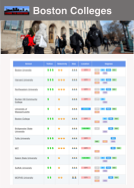


Boston warmly welcomes international students from around the world. The Greater Boston area hosts tens of thousands of international students, with institutions like **Northeastern University** and **Boston University** each enrolling over 10,000 students from more than 140 countries. Most colleges provide dedicated international student offices to support admissions, visa processes, orientation, and ongoing success.
Admission policies for international students vary by school — always check the specific requirements on each college’s website.
Application Process
Some schools use a dedicated international application, while many accept the Common Application (often with an international supplement). Start early and pay close attention to deadlines.
English Language Proficiency
If English is not your native language, you’ll need to demonstrate proficiency. Accepted tests include the **TOEFL iBT**, **IELTS**, or **Duolingo English Test (DET)**. Minimum scores typically range from 90–100+ on TOEFL iBT, 7.0 on IELTS, or 120–135 on Duolingo, but requirements vary by program and school. Waivers may be available if you’ve studied in English-medium schools.
Academic Records
Submit official secondary school records (transcripts, diplomas, or national exam results) from the last 3–4 years. Transfer students need official college transcripts. All non-English documents must include certified English translations. Some schools require credential evaluation services (e.g., WES or NACES members).
Letters of Recommendation
Most colleges require 1–3 letters, preferably from teachers or counselors who know you well. They should be written or translated into English.
Student Visas (F-1)
To study full-time in the U.S., you’ll generally need an **F-1 student visa**. The process includes:
- Receiving admission and a Form I-20 from your college
- Paying the SEVIS fee
- Completing the DS-160 visa application
- Scheduling and attending a visa interview at a U.S. embassy/consulate
Your college issues the I-20 after you accept admission and provide proof of sufficient financial resources. Start this process as soon as possible.
Proof of Financial Support
Colleges require documentation showing you (or your sponsors) can cover tuition, living expenses, and other costs for at least the first year. This usually includes bank statements, sponsor letters, and scholarship awards. Some schools issue the I-20 only after receiving these documents.
Housing
On-campus housing is often guaranteed for first-year students. For off-campus options, start searching early (January–April for September move-ins). For more tips, see our student housing guide.
Health Insurance
Boston has world-class healthcare. All colleges require international students to have U.S.-compliant health insurance (foreign policies are usually not accepted). The school’s student health plan is typically the easiest and most comprehensive option. See our health insurance guide for details.
Cell Phones & Communication
Most international phones incur high roaming fees. Purchase a U.S. SIM card or phone upon arrival. For details, check our cell phone guide for students.
Driving in Massachusetts
You can drive with a valid foreign license (plus an International Driving Permit if not in English) for a limited time. For longer stays, obtain a Massachusetts driver’s license at the RMV. Bring your passport, I-20, I-94, proof of Massachusetts address, and other required documents. See the Massachusetts RMV website for current rules.
Boston’s international student community is large, supportive, and diverse. Reach out to each college’s international office — they are excellent resources throughout the process and your studies. Welcome to Boston!
Last updated: July 2026. Visa rules and requirements can change — always verify with official U.S. government and school sources.